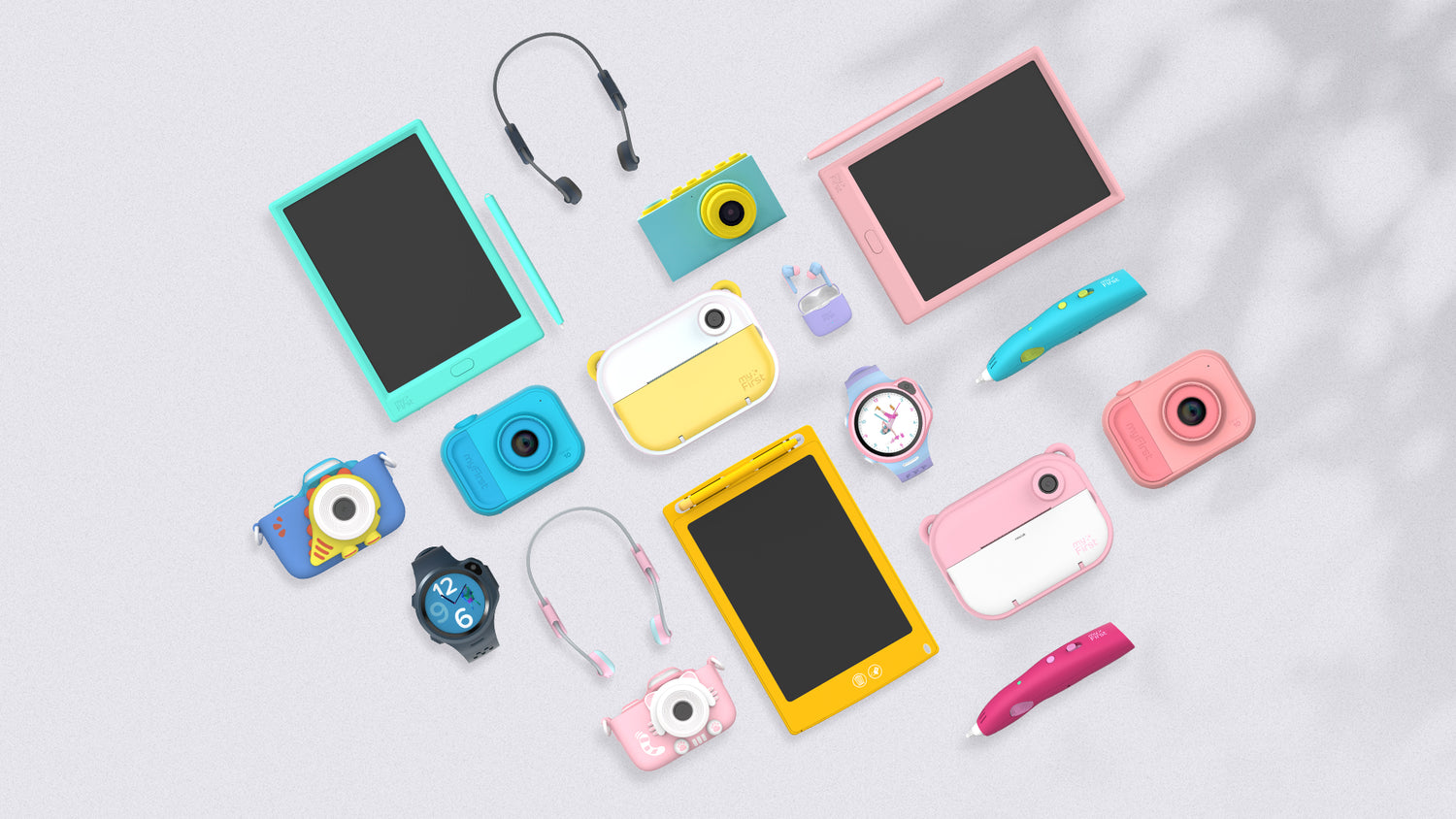
Why Digital Drawing Pads Are the Secret to Better Fine Motor Skills| myFirst
The scienceThe hidden brain benefits of your child’s doodles
Last Tuesday, I discovered a family portrait, rendered in permanent marker, floor to ceiling, across my hallway wall. Every family member accounted for. Surprisingly accurate likenesses. Absolutely zero remorse from the artist.
Before I reached for the magic eraser, something stopped me. Not sentimentality. Science. That scribbling wasn’t vandalism. It was neurodevelopment in action. Every wobbly line, every accidental spiral, every suspiciously large head, all of it was my child’s brain doing something remarkable: wiring itself. The repetitive grip of a crayon or stylus builds the tiny hand and wrist muscles that form the very foundation of fine motor skills. The mess, it turns out, was the point.
I still cleaned it off!
But, the point is, as they track their tool across a surface, they learn exactly how much pressure to apply and how to make a line stop exactly where they want it to. It’s also, neurologically speaking, one of the most complex physical and mental workouts a young child can do.
The benefits don’t stop there. A landmark study from the University of Surrey involving over 9,000 children found that early drawing and building skills are linked to stronger academic outcomes. They even lead to fewer behavioral problems later in life.
The good news? You don’t have to sacrifice your walls to get these developmental payoffs. Today’s interactive drawing for kids delivers the exact same benefits as traditional paper and crayons. Just without the cleanup.
The differenceWhen the screen is a sketchbook
Most parents have been there. You hand over a tablet in a moment of desperation. You just need ten minutes to answer an email or cook dinner. What happens next depends entirely on what’s on the screen.
But not all screen time is created equal. Watching cartoon unboxing videos is passive, it delivers quick dopamine hits without asking anything of the brain in return. Creating something is the opposite of that.
It’s active. These pads demand focus, intention, and physical engagement.
Picture a long road trip. Or a tedious wait at the doctor’s office. Or a rainy Sunday afternoon. Instead of a child passively staring at a glowing screen, a fun sketchpad for kids turns downtime into a tactile, pen-on-paper-like experience.
They actively decide what to create, practice their grip and refine their spatial awareness. Because these devices are designed specifically for drawing, there are no pop-ups, no auto-playing videos, just the work of creating something.
It’s a tool that proves doing beats consuming, every single time.
The mechanismHow the right drawing tablet actually trains little hands
When it comes to developmental benefits, the hardware matters just as much as the concept. You want a device that mimics the feel of real drawing.
A large format is the place to start. It gives kids the physical room to make broad, sweeping arm movements. Later, they refine these into smaller, controlled wrist actions.
Then there’s the stylus. Unlike a chunky crayon that forgives a fist grip, a stylus demands precision. Kids have to apply intentional pressure and steer each stroke with care. That demand naturally nudges most children toward a tripod grip, the three-finger hold that occupational therapists identify as a key marker of handwriting readiness. No drilling required. The tool teaches it.

An anti-glare screen quietly does its part too. When kids aren’t squinting or repositioning to dodge reflections, their attention stays exactly where it should, on the physical act of drawing itself.
And durability is non-negotiable. Reinforced corners mean the device survives the drops and bumps of childhood. A tool kids can actually reach for every day is the only kind worth buying.
The timingRight device, right stage
No piece of technology is inherently right for a child. What makes it right is timing, meeting them exactly where their development is, not where we wish it were.
Parents often find that handing a complex, feature-heavy tablet to a preschooler backfires. It results in frustration rather than creativity. They spend more time accidentally closing apps than actually drawing. They get lost in menus.
Conversely, an older child will quickly outgrow a basic magnetic doodle board. They want something that feels real and respects their growing artistic skills.
You want a device that feels intuitive immediately, but still has enough precision to keep them engaged as their artistic abilities and motor skills mature.
A dedicated digital drawing pad for kids hits this balance perfectly, growing with the child from their first wild scribbles to detailed, intentional sketches.

Our top pickBuilt for hand-eye coordination
It's engineered specifically to replicate the friction and feel of pen on paper, which is essential for developing the tactile feedback loop required for strong hand-eye coordination.
The portability factor is just as considered. It’s lightweight enough to go anywhere. Those fine motor skill workouts can happen in the car, at a restaurant, or right there on the living room floor. Plus, it comes with a free leather case. It makes it feel like a proper tool, the kind that keeps them engaged longer and makes them feel responsible and proud of their gear.
It’s a device around one purpose, giving children the focused, physical experience of making something real.
The takeawayTurning a natural habit into a developmental win
Kids are natural creators. That instinct to draw, scribble, and sketch is one of their most valuable developmental phases. It is how they process the world around them.
The goal isn’t to force them into structured art lessons. It is simply to provide the right tools. The right tools simply get out of the way, and let a natural habit become a developmental win.
By swapping passive screens for active, tactile drawing experiences, you’re building skills they’ll carry into the classroom. You are setting them up for success in a way that feels like pure fun to them.
Sketch Clear is built for creative and skill-building plays, at home, on the road, or anywhere the day takes them. And that chaotic scribble on the wall? It was just the beginning of something.
Kids are natural creators. The right tool just gets out of the way, and lets a natural habit become a developmental win.
And that chaotic scribble on the wall? It was just the beginning of something.
Explore the Sketch Clear