Why Your Kid's Motivation Keeps Draining Away
Kids & Motivation
Your child's favorite app is a machine built to keep them pulling a lever. The pull is a swipe, the lever is a feed, and the pellet is a like that may or may never arrive.
This is the architecture of modern childhood, and most adults are caught in the same loop. The real cost is what that loop does to the part of a kid that used to just want to do things.
Intrinsic motivation is the quiet engine behind every hobby, every friendship, every hard thing a person chooses without being paid. When it gets extracted, what remains is a child who waits to be told what comes next.
The dopamine economy built to keep kids pulling
 Behavioral science has a precise name for a reward that shows up on an unpredictable schedule: variable-ratio reinforcement. B.F. Skinner found that this schedule produces the most persistent behavior of any reward pattern. It's exactly why slot machines keep people pulling.
Digital products borrowed the design on purpose. A pull-to-refresh, a notification badge, an endless scroll: each is a slot-machine lever in a pocket, tuned to fire the brain's anticipation circuit whether or not the reward lands, the same variable-ratio schedule Skinner formalized in the lab, later documented as a deliberate design choice built into real slot machines.
When the reward is uncertain, the wanting never stops. Your kid swims in that water before they can read.
The environment is designed. Engineers optimize for the next open, the next scroll, the next return, because attention is the product and a child's curiosity is the raw material. None of this makes a child bad. It makes the extraction environment the default, and the default is what shapes drive.
The screen time that frames the problem
Common Sense Media's most recent census puts average daily entertainment screen use at 5 hours 33 minutes for tweens (ages 8 to 12) and 8 hours 39 minutes for teens (ages 13 to 18).
Most of that time is consumption engineered to hold attention. The point isn't the hours alone. It's that the hours are spent inside systems built to reward the next tap, not the thing made.
Why rewards might backfire
 Somewhere in a kitchen drawer is a sticker chart with exactly four stickers on it, abandoned around week two, right after the novelty wore off and the whole system quietly died.
A 1999 meta-analysis covering 128 studies found that tangible, engagement-contingent rewards undermine intrinsic motivation, and the harm was larger for children than for adults. The same analysis found something else, though: informational positive feedback, the kind that names what a kid did well, builds drive.
Rewards don't stack motivation on top of interest. They replace it. Remove the reward and the behavior collapses, because the child was never doing it for the doing.
Growth mindset for kids is fighting the reward machine
A growth mindset for kids isn't a slogan for a poster. Kids who learn to credit effort rather than fixed ability keep going when things get hard, because they've stopped treating every attempt as a verdict on whether they're smart.
That's the real link back to the reward machine, and it's not a stretch. Praising ability instead of effort quietly turns intelligence into something a kid now has to defend, a label to protect rather than a thing to build. That's its own reward system in disguise, no different in kind from a like or a streak, just dressed up as a compliment instead of a badge.
Praise the process instead, and there's nothing left to defend, only something worth continuing.
I've caught myself telling my own kid how smart she is more times than I'd like to admit, and I've watched the little one go quiet right after a wrong answer, like the label suddenly had something riding on it.
Naming a kid's intelligence teaches them to guard it. Naming their persistence teaches them to keep going.
The kinder-looking cousin of helicopter parenting
We have learned to spot the hovering parent. The quieter problem is the one who smooths every edge with a treat, a screen, or a prize.
Over-rewarding hides behind care. The treat after dinner, the screen to keep them quiet, the prize for a task they could enjoy: each one teaches the child that the activity is the price and the reward is the point.
The fix isn't less love. It's hands underneath, not hands with treats. Let them want the thing for itself.
The unmediated fix: myFirst Insta and myFirst Sketch
 The antidote is a tool that returns the reward to the act.
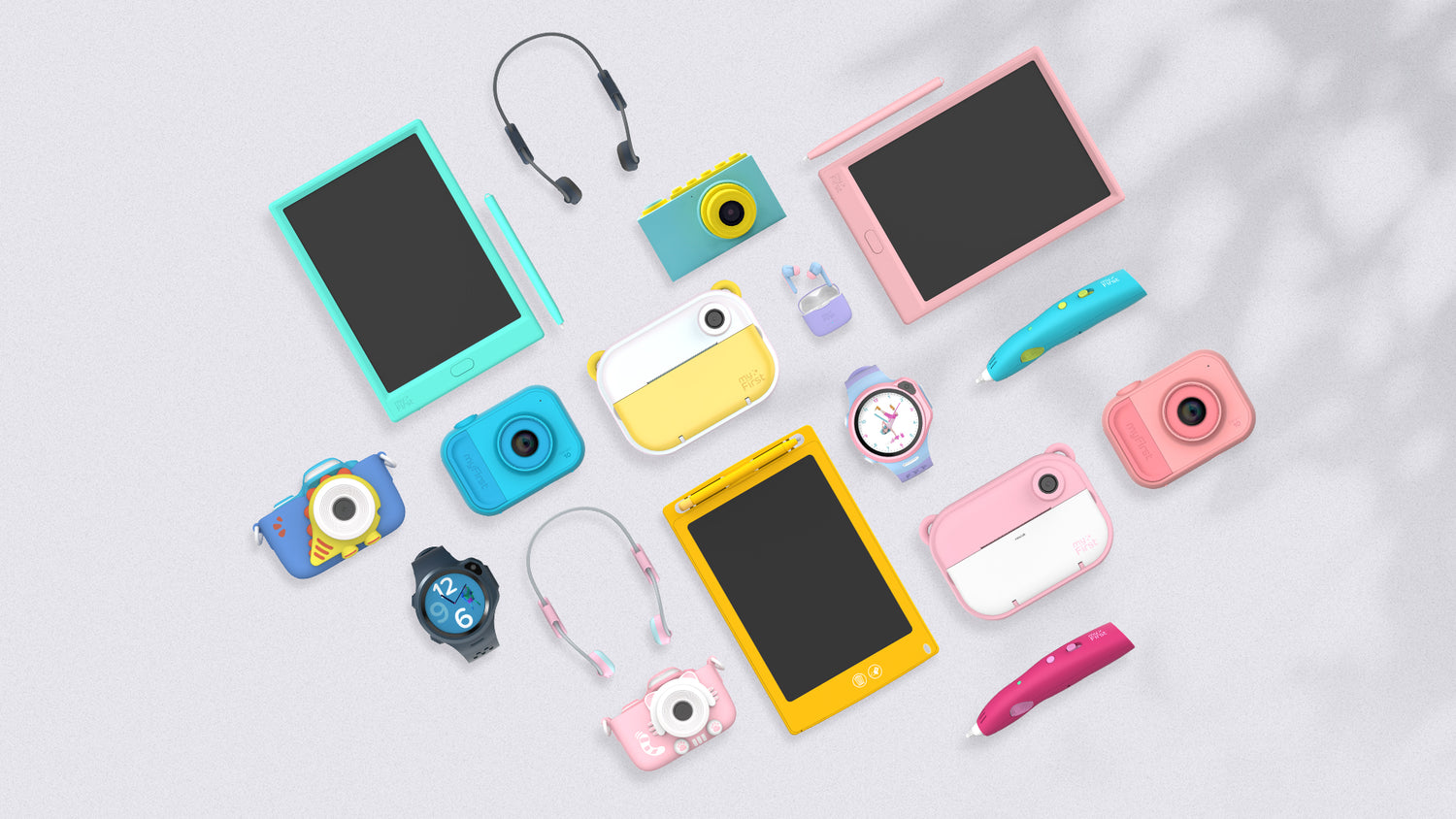
The myFirst Insta is an instant print camera, a children's digital camera built around one idea: a child shoots, and a real photo comes out they can hold, tape to a wall, or give to a grandparent. The making is the reward.
Most of the kids camera category still chases the same loop it's supposedly replacing, more takes, more redos, more chances to get the shot just right before anything actually counts.
A digital camera for kids built around an instant, physical print skips that part entirely: the shot happens, the photo exists, and there's no try again standing between the moment and the memory.
These are unmediated creations, the behavioral opposite of the machine described above. Let the kid make something that exists offline.
Key Takeaways
- The modern reward environment uses variable-ratio reinforcement (unpredictable likes, streaks, scrolls) to extract motivation at industrial scale.
- Tangible rewards undermine intrinsic drive more in children, while informational feedback builds it.
- A growth mindset works against reward-extraction by praising process, not outcome or gold stars.
- Over-rewarding is the sneakier cousin of over-controlling; the evidence-based fix is autonomy support, not fewer treats.
- Unmediated creation tools like the myFirst Insta camera give kids a reward that is real, not algorithmic.