How Social Media Teaches Kids to Label Before They Understand
Emotional Literacy / Social Media
There's a well-established concept in emotion research called emotional granularity: the ability to identify and describe feelings with precision rather than reaching for broad, crude labels.
A 2025 scoping review in the Journal of Adolescence found that better emotional granularity supports more adaptive selection and use of emotion regulation strategies in adolescents.
A separate 2025 study of 407 junior high school students found that lower emotional granularity was linked to higher social anxiety and worse interpersonal functioning.
Both point the same direction: kids who reach for a ready-made label instead of differentiating a feeling tend to regulate it worse and struggle more in their relationships.
How therapy speak undermines a kid's emotional vocabulary
Therapy speak skips that harder work entirely. It hands a child a ready-made label, toxic, gaslighting, narcissist, before they've built the capacity to tell a real pattern from a bad day.
The scale is worth pausing on. A LifeStance Health survey found that 40% of respondents encounter this vocabulary on social media daily or multiple times a week, and half of Gen Z adults regularly use it themselves.
The survey calls it therapy speak: clinical terms, stripped of context, distributed through short-form video.
The pattern matters because the vocabulary travels faster than the understanding. A 12-year-old who learns gaslighting from a TikTok learns that disagreement now has a word, and the word makes the other person wrong.
The label arrives before the literacy needed to apply it, the exact gap the granularity research describes.
What happens when kids use therapy speak instead of understanding their feelings
The LifeStance survey found that 32% of adults have questioned their relationships because of social media content.
52%
labeled the other person toxic
45%
called it gaslighting
28%
said love bombing
Serious clinical concepts, reduced to shorthand for someone I'm upset with.
Apply that to a child. A nine-year-old has a playground disagreement. A teenager tells a parent their boundary was crossed and the parent is being toxic.
The vocabulary gives them certainty without comprehension. They have a label for the feeling. They lack the capacity to evaluate whether the label fits, the exact deficit linking to worse regulation and worse relationships.
In short, the label replaces the process. Instead of sitting with a feeling and working through it, the child categorizes the other person and moves on.
 Why emotional vocabulary needs to form before social media does
The LifeStance data shows a generational gradient that should concern parents of younger kids. Gen Z, who got social media access in their early teens, already leads every metric in therapy speak adoption. Today's under-13 cohort is getting devices even earlier. The vocabulary will arrive younger too.
What fills those years matters. Emotional vocabulary develops through experience.
A child who photographs a sunset and shows it to a parent is learning to share a feeling without words.
A child who calls their grandmother on a Sunday afternoon is learning that relationships take effort, and that effort feels good.
A child who argues with a sibling and works through it is learning that conflict is survivable, and that resolution is a skill.
These experiences build an internal vocabulary. When the algorithm eventually arrives with labels, the child has a foundation to weigh them against. Without it, the labels become the vocabulary.
 How a kids smartwatch and camera build emotional skills a feed can't
The device choice during the formation years determines what fills the window. A smartphone puts a feed in a child's hands. That feed is designed to maximize engagement. Therapy speak content is highly engaging because it offers certainty and moral clarity in 60 seconds.
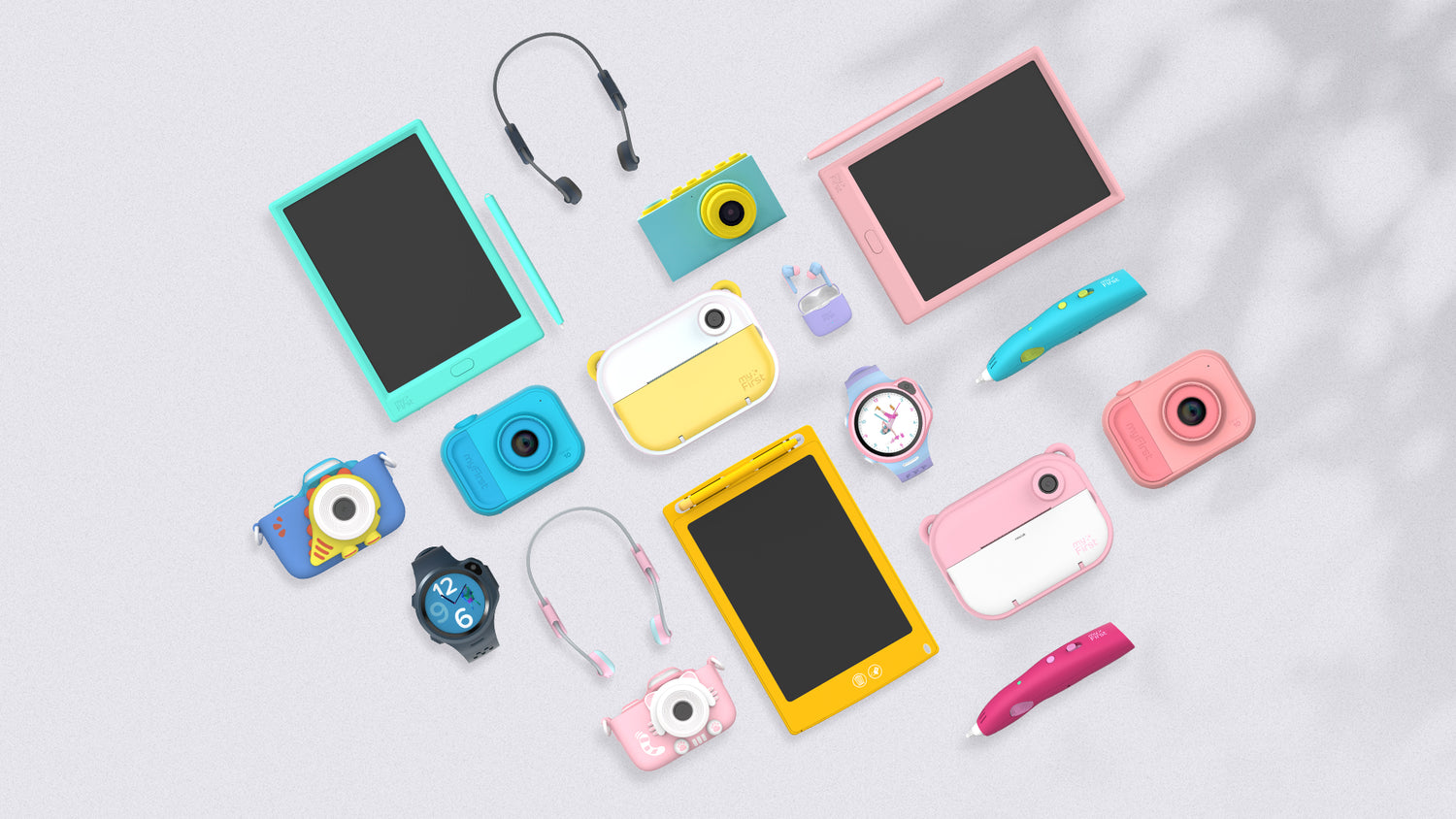
Non-social devices offer a different input. A kids smartwatch like the myFirst Fone S4 provides calling and location safety without a browser, app store, or social media. It's the kind of kids smart watch with GPS that lets a parent know a child is safe without a single algorithm involved.
What the child practices instead:
Calling a parent
Leaving a voice message
Sending a vibration through magiCode that means I need you
No feed competes with these acts.
Cameras offer another path. A kids camera, or any camera for kids built without social features, gives a child room to create without an audience.
The myFirst Camera 50 lets a child capture their day and choose what to keep. A myFirst Insta 20 produces a physical print the child can hold, share with one person, or keep private.
Photography is emotional processing. The child frames the shot, decides what matters, and no algorithm curates the experience or grades it.
A child who has spent years capturing real moments, calling real people, and navigating real conflicts has something to compare a TikTok label against. A child whose window was filled with a feed has nothing.
 How to teach kids emotional vocabulary before the algorithm does
None of this means banning devices that connect kids to people. It means being deliberate about which ones fill the years before a feed arrives.
A children's smart watch or camera gives kids tools for real connection and creation, without the engagement loop that distributes therapy speak in the first place.
The point isn't hunting down the best kids camera on a spec sheet. It's picking one built for use, not for time spent, which matters more than any single feature on the box.
The device choice only does half the work. The other half happens at home, in the actual words used for feelings.
That was toxic.
That made you feel unheard, and that's frustrating.
Specificity is the antidote to premature labeling. It's exactly what the emotional granularity research above says helps regulate feelings in the first place.
And let relationships stay messy in the meantime. Therapy speak offers clean categories, but real relationships are unresolved, complicated, and worth the effort anyway.
A child who learns to sit with that discomfort develops something a label can't provide: the capacity to understand another person without filing them under a clinical term.
The goal isn't to shield kids from mental health language forever. It's making sure that when the language arrives, it meets a child who already has a vocabulary for their own experience.
Key Takeaways
- Emotional granularity, the ability to name feelings precisely instead of reaching for crude labels, is linked to better emotion regulation and healthier relationships.
- Therapy speak works against emotional granularity by handing kids a ready-made label, toxic, gaslighting, narcissist, before they've built the skill to tell a real pattern from a bad day.
- Half of Gen Z adults regularly use this vocabulary, and 32% have questioned a relationship because of it, showing how widespread the shortcut has become.
- The years before social media access are when emotional vocabulary forms through direct experience, not curated content.
- Cameras and kids smartwatches give children tools to process real moments and practice real relationships before algorithmic labels arrive.